
 English
 Español
 Portugues
 Pусский
 Français
 Deutsch
 日本語
日本語 한국어
한국어 العربية
 Italiano
 Nederlands
 Svenska
 Polski
 Türk dili
 हिन्दी
 Indonesia
 Melayu
 dansk
dansk Magyar
 қазақ
қазақ বাংলা
বাংলা עִברִית
 čeština
 українська
 беларускі
 Filipino
 Suomalainen
 اردو
اردو հայերեն
 български
 Hrvatski
 galego
 नेपाल
नेपाल euskara
 Shqipëria
 Malagasy
 Башҡорт
 Ilocano
 Нохчийн


Aluminum electrolytic capacitor
Aluminum Electrolytic Capacitors: Overview and Applications Aluminum electrolytic capacitors are a widely used type of capacitor known for their high capacitance values and cost-effectiveness. They are commonly employed in power supply circuits, audio systems, and various electronic devices where large capacitance in a compact form factor is required. These capacitors consist of an aluminum anode foil, an electrolyte (usually a liquid or solid conductive material), and an aluminum oxide layer that acts as the dielectric. Construction and Working Principle The core of an aluminum electrolytic capacitor is the anode, made of high-purity aluminum foil that is etched to increase surface area. This foil is anodized to form a thin aluminum oxide (Al₂O₃) dielectric layer. The cathode consists of another aluminum foil or a conductive electrolyte. The electrolyte facilitates ionic conduction, ensuring electrical contact with the cathode. The entire assembly is housed in an aluminum can, sealed to prevent electrolyte leakage. When voltage is applied, the oxide layer on the anode acts as an insulating barrier, allowing charge storage. The capacitance depends on the surface area of the anode and the thickness of the oxide layer. Higher voltage ratings require thicker oxide layers, which reduce capacitance per unit volume. Key Characteristics 1. High Capacitance: Aluminum electrolytic capacitors offer capacitance values ranging from a few microfarads (µF) to several farads (F), making them ideal for filtering and energy storage applications. 2. Polarity Sensitivity: These capacitors are polarized, meaning they must be connected with the correct voltage polarity to avoid damage. 3. Limited Lifespan: The liquid electrolyte can dry out over time, especially at high temperatures, leading to reduced performance and eventual failure. 4. Equivalent Series Resistance (ESR): They exhibit higher ESR compared to other capacitor types, which can affect performance in high-frequency applications. 5. Temperature Sensitivity: Performance degrades at extreme temperatures, so proper thermal management is crucial. Applications - Power Supplies: Used for smoothing and filtering in DC power circuits. - Audio Equipment: Employed in coupling and decoupling applications due to their large capacitance. - Industrial Electronics: Found in motor drives, inverters, and lighting systems. - Consumer Electronics: Used in televisions, computers, and gaming consoles. Advantages and Limitations Advantages: - High capacitance-to-volume ratio. - Cost-effective for bulk capacitance needs. - Suitable for low-frequency applications. Limitations: - Limited lifespan due to electrolyte evaporation. - Sensitive to reverse voltage and high temperatures. - Higher ESR compared to ceramic or film capacitors. Conclusion Aluminum electrolytic capacitors remain indispensable in electronics despite their limitations. Their ability to provide high capacitance in a compact package ensures continued use in power and signal conditioning applications. Advances in solid electrolyte designs are improving their reliability, making them even more versatile for modern electronics.
Önümler
kategoriýa:
-
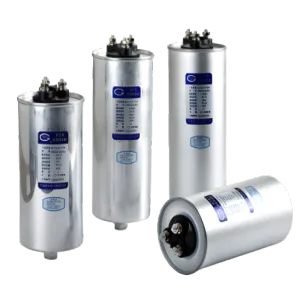
Low Voltage Shunt Power Capacitor
Klassifikasiýa: CapacitorGörülenleriň sany: 52San:Çykan senesi: 2025-12-16 10:00:52Cylindrical Capacitor: Engineering Principles, Performance Factors, and Industrial Applications Industry Background and Market Demand As global industrial systems move toward higher efficiency, stability, and energy optimization, capacitors have become indispensable components in power electronics and electrical infrastructure. Among various form factors, the cylindrical capacitor has gained wide adoption in low- and medium-voltage power systems due to its compact geometry, mechanical robustness, and favorable thermal performance. Industries such as manufacturing automation, HVAC systems, elevators, renewable energy integration, and power distribution increasingly rely on reactive power compensation to improve power factor, reduce losses, and stabilize voltage. This demand is particularly strong in regions with stringent energy efficiency regulations and high penetration of inductive loads. Cylindrical designs are well suited for these environments because they balance electrical performance with installation flexibility and long-term reliability. The market trend also reflects a shift from simple capacitive components toward engineered assemblies with enhanced safety mechanisms, predictable lifetimes, and compliance with international electrical standards. In this context, cylindrical capacitors are no longer treated as commodity parts but as engineered solutions within larger power management systems.
Habarlar
kategoriýa:
-
[Industry News]Cylindrical Capacitor Design and Applications in Industrial...
2025-12-25 09:35:38
Kazyýet
kategoriýa:
Gözleg netijeleri ýok!
Wideo
kategoriýa:
Gözleg netijeleri ýok!
süklemeler
kategoriýa:
Gözleg netijeleri ýok!
Işe almak
kategoriýa:
Gözleg netijeleri ýok!
Maslahat berilýän önümler
-
NEWS
Low Voltage Shunt Power Capacitor
Has giňişleýin öwren



 Whatsapp
 Telefon